
A Hill Sachs lesion is a fracture of the head of the humerus bone. The head of the humerus articulates with the scapula’s glenoid fossa and labrum forming the shoulder joint. Hills Sachs lesions occur most commonly after a dislocation of the shoulder. With such injuries, the glenoid of the scapula bone becomes exposed due to the integrity of the labrum being compromised from the dislocation. Because of this, the head of the humerus bumps up against the rim of the newly exposed glenoid fossa when it is returning to it’s normal anatomical position, causing a dent or fracture in the back of the head of the humerus. These dents can vary in size and severity, which influence overall treatment rehabilitation of the injury.
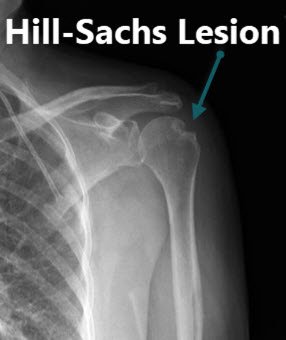 Hill Sachs Lesion
Read Shoulder Anatomy to learn more about the anatomy of the shoulder joint.
What Are The Symptoms Of a Hill Sachs Lesion?
- Pain in the shoulder
- Inflammation in the shoulder joint (swelling and/or bruising)
- Limited motion of the shoulder
- Weakness in the shoulder
- Feeling like the shoulder is unstable
- Visible shoulder deformity (typically in the front of the shoulder)
How Do You Know If You Have a Hill Sachs Lesion?
If you believe you may have a Hill Sachs lesion, you should schedule an appointment to see a Physician for an evaluation. They will evaluate the injured shoulder to determine if you need to be referred for imaging. Imaging may be required to fully diagnose a Hill Sachs lesion, which can include magnetic resonance imaging (MRI), Ultrasonography, and/or computed tomography (CT) scan. After a thorough physical examination and possible imaging, the Physician will develop a treatment plan of care.
Does a Hill-Sachs Lesion Require Surgery?
Treatment options for a Hill Sachs lesion are based on different factors including the lesion’s size and location, the involvement of the glenoid, and how much it affects the mobility of your shoulder. Conservative treatment or rehabilitation is often performed for Hill Sachs lesions of smaller sizes that involve less than 20 percent of the head of the humerus. For Hill Sachs lesions that involve more than 40 percent of the humeral head, surgical treatment is almost always needed. For lesions that involve between 20 and 40 percent of the humeral head, surgery will be determined based on whether your surgeon thinks that the lesion is affecting your shoulder stability or not.
What is Conservative Treatment For a Hill Sachs Lesion?
Rehabilitation is used as treatment for a Hill Sachs lesion when a patient is not a good candidate for surgery or may not require surgery. The patient’s rehabilitation program should focus on strengthening the rotator cuff muscles, the deltoid muscles, and the muscles that stabilize the scapula. It should also work to restore range of motion, or mobility of the shoulder joint. Such a program should be performed under the supervision of a Physical Therapist and supplemented with a structured home exercise program.
What is The Difference Between a Hill Sachs Lesion and a Bankart Lesion?
Both lesions occur often as a result of a shoulder dislocation. In some cases, a patient may develop both a Hill Sachs lesion and a Bankart lesion. Bankart lesions often occur from repeated forward shoulder subluxations, where the humerus slips out of place and then falls back into its correct position. This can cause damage around the labrum of the glenoid. A Bankart lesion occurs in the front lower portion of the glenoid labrum and can sometimes be associated with a fracture in the adjacent glenoid rim.
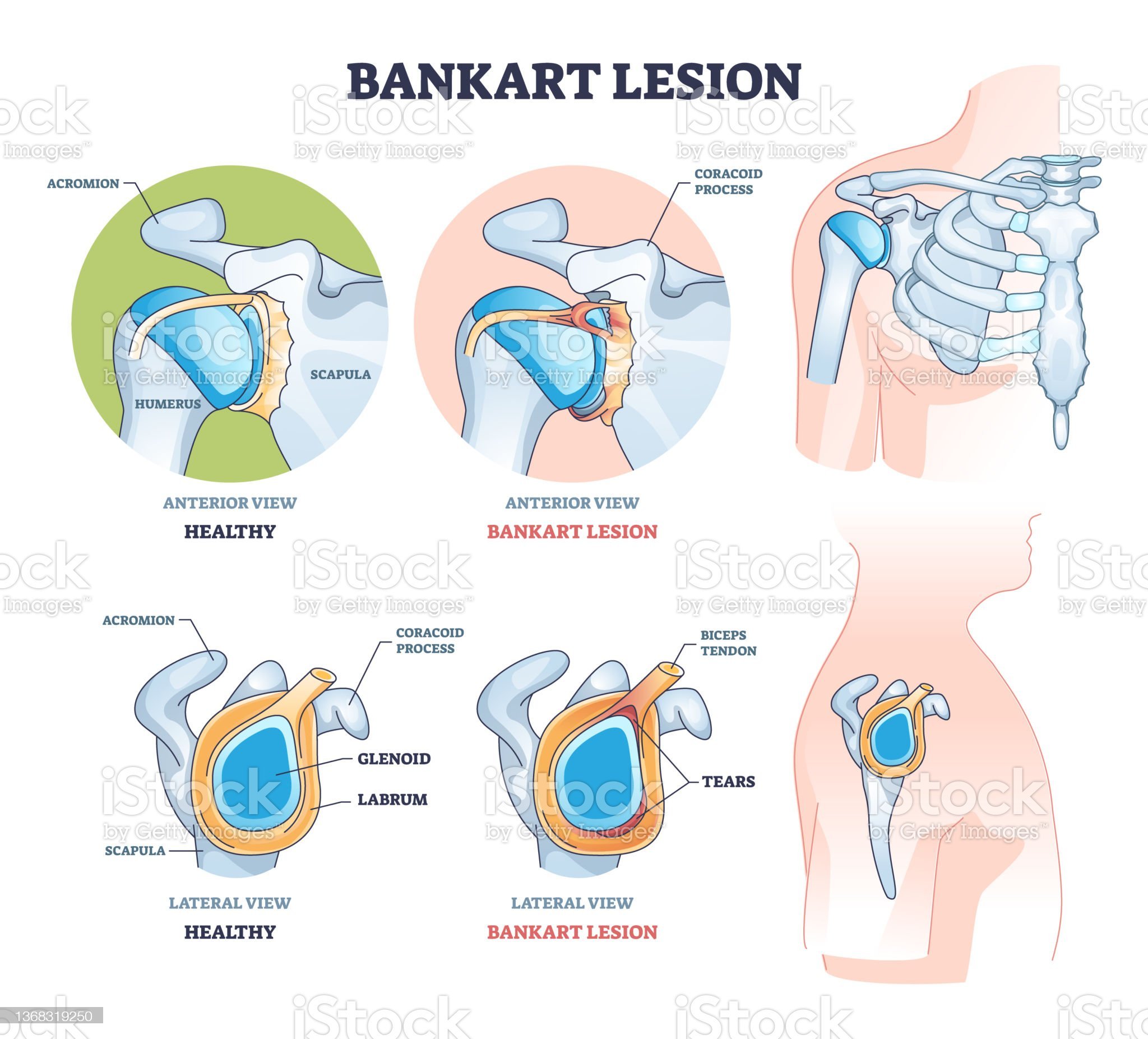 Bankart Lesion of the Shoulder
To learn more about a injuries that can occur with a shoulder dislocation read this Shoulder Dislocation article.
What If I Have a Hill Sachs Lesion or Other Shoulder Pain?
If you think you may have a Hill Sachs lesion or just simply have shoulder pain that can’t wait, JOI is here for you! We have 5 convenient Physician Offices with Physicians specialized in treating the shoulder. To schedule an appointment today call 904-JOI-2000 or click the button below.
If you have seen an appointment and need to schedule Physical Therapy, call 904-858-7045 to get you started!