

Rotator cuff tears are a common injury that affects millions each year across the globe. Because of its prevalence, you may have heard of the rotator cuff, but you might not realize what it is or how it keeps your shoulder stable and mobile.
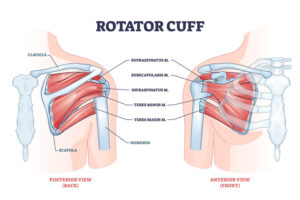
The rotator cuff refers to a group of muscles and tendons that work together to move your shoulder in a variety of directions, including lifting your arm, down, and in circles. The group of muscles includes the subscapularis, infraspinatus, teres minor, and the supraspinatus. Together, these muscles keep your shoulder joint stable so it can function properly and move appropriately.
Rotator cuff tears require treatment from an orthopedic doctor, as the individual experiencing a tear in the rotator cuff will endure pain, limited mobility, and, in cases of complete or severe tears, it could result in an inability to move or lift their arm. A rotator cuff tear is a serious shoulder injury that often requires orthopedic surgery and rehabilitation.
If you suspect you may be experiencing a rotator cuff tear, you can be proactive. By understanding what a rotator cuff tear is, the common symptoms, how it is treated, and what recovery looks like, you’ll be in a better position to advocate for yourself and make appropriate choices regarding the care of your shoulder injury.
What Is a Rotator Cuff Tear?
A rotator cuff tear occurs when either muscles in the rotator cuff or the tendons that connect the muscles are torn. It can be a complete or full-thickness tear, where there is full separation, or a partial tear, where the muscle or tendon is damaged but not completely torn.
There are a variety of reasons a person may experience a rotator cuff tear, which could range from an acute injury to gradual wear and tear. Acute injuries are sudden, traumatic events in the sense that the shoulder has been injured in a single event. This could be something as seemingly benign as a fall to more serious injury, like a collision.
Common Symptoms of a Rotator Cuff Tear
If you suspect a rotator cuff tear because you experienced a shoulder injury or because something just isn’t feeling right, some symptoms could indicate a tear. Pay close attention to where you are feeling pain or weakness.
Shoulder pain, particularly when reaching overhead or raising your arms overhead (or attempting to do so), can indicate a rotator cuff tear. If you’re experiencing weakness or a limited range of motion, that could also point to something being wrong with your shoulder. Please keep in mind that sudden weakness on one side of your body could be a sign of a stroke, so seek immediate medical attention if it happens on one whole side of your body and comes on suddenly.
You may also notice you have a hard time sleeping on your side, especially if that’s how you normally sleep, if you have a shoulder injury. Another symptom to watch out for is to carefully listen and feel for clicking, popping, or cracking sensations when you attempt to move your shoulder. Ultimately, these symptoms mean it’s time to contact an orthopedic doctor for an evaluation.
How Rotator Cuff Tears Are Diagnosed
When you schedule an appointment with an orthopedic specialist to determine if you have a rotator cuff tear, you likely want to know what to expect. Like with any visit to a new doctor, you’ll want to have your medical history handy and be ready to talk about your shoulder injury symptoms. Your doctor will want to know if you have a family history of arthritis or orthopedic issues, as well as your standard medical history.
Your orthopedist will conduct a thorough physical examination of your shoulder to determine your strength, mobility, and pain level. During their assessment, they will want to know how long the pain and/or weakness has been occurring and if there was an acute injury or if this is something that seemingly just started happening.
Following the physical examination, the orthopedist will likely send you for imaging so he or she can get a better picture of what is going on with your joint. This will include bone imaging, which would include X-rays and/or a CT scan, as well as an MRI and/or ultrasound to look at the soft tissue and determine the severity of the rotator cuff tear or determine what else is going on. This imaging will be necessary to make a diagnosis.
Shoulder Injury Treatment Options
Once you have been diagnosed with a rotator cuff tear, you will want to know your treatment plan. Your orthopedic doctor will review your options, starting with the least invasive and including orthopedic surgery. Every person and shoulder injury is different, so your doctor will make personalized recommendations based on your particular situation and what the imaging dictates.
Nonsurgical treatments typically include making lifestyle changes, ensuring adequate rest and activity modification for a period of time while your shoulder heals, and physical therapy to help stabilize the muscles and rebuild strength. For pain management, doctors may prescribe or recommend over-the-counter anti-inflammatory medications or may administer corticosteroid injections if indicated.
Most orthopedic surgery treatment options to repair shoulder injuries are arthroscopic, meaning they won’t have to cut your whole shoulder open to repair. Instead, the surgeon makes small incisions for a small camera and tools to perform the repair. The severity of the tear and other factors will affect which treatment option your orthopedic doctor recommends.
Following surgical treatments, physical therapy is required as part of the rehabilitation process. You’ll want to follow all advice to protect your shoulder during recovery, including guidance on returning to work, sports, and other activities that use or could impact your shoulder.
Fear a Rotator Cuff Tear? Contact an Orthopedic Specialist
If you are concerned you may have a rotator cuff tear or shoulder injury, it is best to contact an orthopedic specialist sooner rather than later. Delaying care could do more harm than good and worsen your shoulder injury. For example, a partial tear, if not treated promptly, could become a complete tear, which means a more intensive repair and a longer recovery. If you have ongoing shoulder pain or weakness, contact the Jacksonville Orthopaedic Institute today to schedule your shoulder injury consultation!